
Well, hasn’t the past few months been an interesting time for the property market?
If you’re like me you’ve been busy reckoning how the budget changes and our property economics might unfold over the next few years.
Will they help younger Aussies into home ownership sooner? Make it easier for older generations to get into the right sized home? Help us all to preserve and grow our wealth?
This goes beyond our budget/tax settings. Interest rates, supply and demand, inflation and wage growth all count, but it’s really affordability and liquidity that move the needle.
Let’s look at New Zealand.
They ended negative gearing in 2019 by ring-fencing rental losses, then went further in 2021 and began phasing out interest deductibility on rental income altogether. They then reversed course and fully restored it by 2025.
Over the same period NZ has also had one of the most volatile property markets.
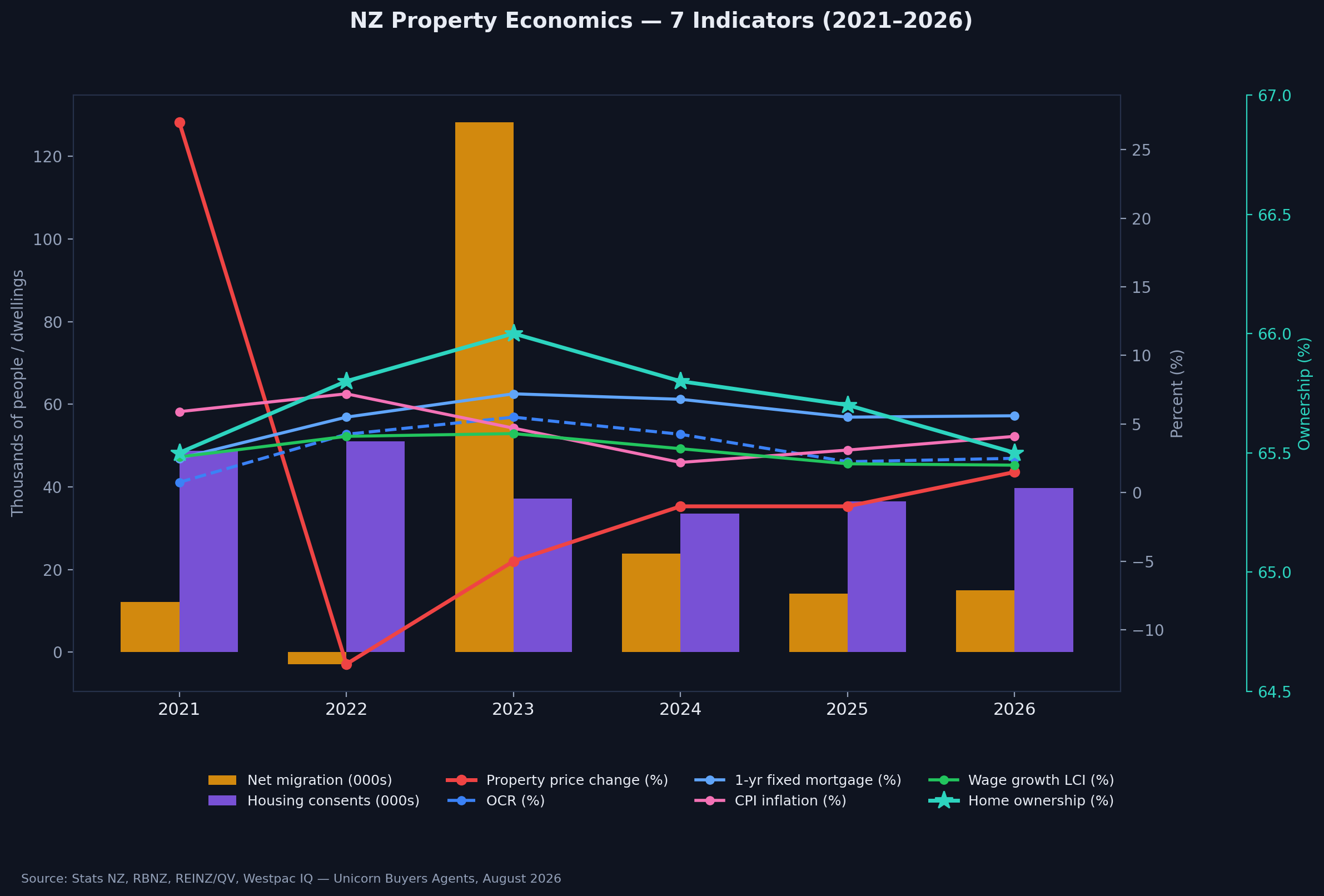
The New Zealand numbers
Prices rose about 27% in 2021, then crashed around 19% from 2022 to 2025, largely a result of fixed mortgage rates increasing from 2.5% to a peak of 7.2% in 2023, then back down to 5.5%.
Housing consents peaked at 51,000 in 2022, but are back around 39,700- a longer term average.
Migration spiked to 128,000 people in 2023, then collapsed to 14,200 by 2025.
Home ownership? Barely changed. It crept up from 65.5% to 66.0% between 2021 and 2023 as prices came down, the first rise since the early 1990s. Then it slipped back to 65.5%. For reference, Australia’s home ownership rate is about 67%.
The record migration surge of 2023 could not push values back up while money stayed expensive. And when migration collapsed in 2025, prices didn’t fall much further either. The rate cycle (the nearly tripling of mortgage rates) did most of the work, in both directions. The tax changes, on and then off again, barely register in the price data at all.
Affordability worsened more than prices pulled back and prices fell hardest in Auckland and Wellington, the most expensive markets relative to income, while the more affordable zones fared better.
What’s the lesson?
Many would be property buyers are celebrating falling property prices but its affordability that counts, not price.
For those who already own property there is either an arbitrage opportunity (selling out of a stronger market into a weaker one) or a willingness to take a haircut on the current place but save more on the next purchase.
First home buyers servicing capacity falls when rates and inflation rise faster than wages, regardless of tax changes, investors exiting price falls, auction clearance rates or any other noise.
Australia can learn this from NZ but we’ll have a different outcome thanks to the trillions in generational wealth changing hands – bigger deposits will bridge the affordability gap.
Our all powerful lending institutions will also no doubt “adjust” serviceability buffers and come up with new lending mechanisms as their loan books (and profits) contract.
And I wouldn’t be surprised to see a nationwide adoption of a land tax system rather than stamp duty if the public coffers suffer from reduced stamp duties off lower transaction volumes (and property prices).
These scenarios are more likely if we see higher inflation and higher rates.
Just some food for thought. Moderating property prices, tax settings, supply, demand, these mean nothing unless new buyers can get an entry point and there’s ample liquidity for existing players. Let’s see if the market responds in coming months and years in a way that creates favourable conditions for us all.
Until next time.
Dan Sofo